What is Offshore Quarantine?
Offshore Quarantine is a web series and site which features movies set in or inspired by the Age of Sail. It is hosted by Captain Arizona in various incarnations. The series began in 2021 as a private watchparty hosted by me, Mike Whybark, for a small group of friends. Initial production efforts began in December, 2020.
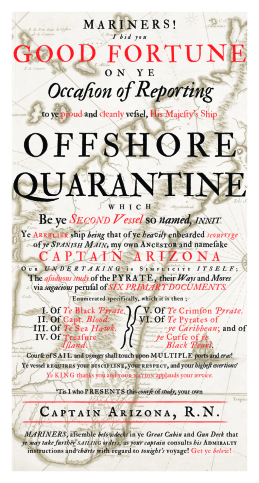
Offshore Quarantine I is hosted by Captain Arizona, a Caribbean buccaneer who was born in England, who lives in the early 16th century and has disdain for naval and royal authority. All of the movies he introduced were strictly concerned with naval service, much to his annoyance: Master and Commander, Old Ironsides, Captain Horatio Hornblower, HMS Defiant, and Mutiny on the Bounty.
Offshore Quarantine II is hosted by a Captain Arizona (whose uniform hints that he is in fact a lieutenant) who serves in the Royal Navy of the very late 19th century, the time of Jack Aubrey, of Nelson, of Captain Bligh. The movies on his slate are The Black Pirate, Captain Blood, The Sea Hawk, Treasure Island, The Crimson Pirate, and Pirates of the Caribbean.
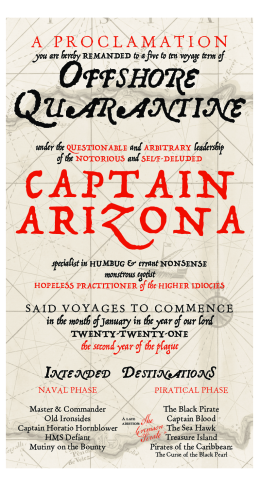
Offshore Quarantine III will be hosted by a Captain Arizona who hails from New England and works primarily as a whaler. The films to be featured are still under consideration.
In general the series presents films in the order of original theatrical release and the events, ideally, occur once a month on Friday evenings. The very first series granted flagship status to Master and Commander in a nod to the role that Patrick O’Brian’s series played in the genesis of the project.
Offshore Quarantine began to germinate as a project in 2020 about six months into the global Corona-19 pandemic. At the beginning of the pandemic I began reading deeply in academic maritime history, especially emphasizing the work of Marcus Rediker, a professor of history at the University of Pittsburgh. On hearing this, my cousin Monty Tayloe suggested to me that I might enjoy reading the Patrick O’Brian Aubrey-Maturin series, which I was aware of because of the influence the books had exerted on the production of Star Trek: The Next Generation. I ripped through them in about a month and during that process had a couple of amusing interchanges with the cartoonist and illustrator Tony Millionaire, who has long been fascinated by tall ships and seafaring and regularly incorporates the imagery into his work.
I started thinking about the relative paucity of contemporary films and television shows which use the Age of Sail as a setting, especially with comparison to episodic science fiction, which in my opinion descends nearly entirely from nautical fiction and movies. I began to make a list of as many films set within or inspired by the Age of Sail as I could. This list is now hundreds of films long. One thing I expected to find, and did, was that there were many more screen-based fiction entertainment projects oriented toward this setting earlier in the history of filmmaking than there are now.
This is unsurprising since the technology of the tall ships was still in regular commercial use even through World War Two, and thus a larger proportion of the moviegoing public would have had exposure to both nineteenth century fiction about the Age of Sail and to the ships themselves than would be likely today. As the technology fell out of everyday use, demand for stories involved with it also fell.
As my list grew, I realized that the Age of Sail film and the constituent works that make up the category are a major genre form that has fallen into neglect to some degree. The descendant relationship of episodic science fiction to the Age of Sail genre led me to think about the goofy ways that genre entertainment has presented itself over time, notably in the form of costumed hosts and tomfoolery for spook shows in theatrical screenings and then later late-night broadcast hosts, which have largely fallen away. I began to wonder if there had ever been a broadcast host for specifically nautical-themed movies. As far as I know, there is only one: Captain Arizona, the host of Offshore Quarantine.
From 2016 to 2020, I did not shave. I knew that I was going to take my eighteen-inch beard off in 2021 and wanted to do something to capture the beard and commemorate it. What better way than to invent a fictional bucaneer who introduces movies as though he were a local TV show host? I had no idea how feasible this project would be and began to look into what it would take to shoot green-screen video and do compositing and editing using only the equipment I had to had: some old Mac laptops, some photographic equipment, miscellaneous recording devices, a couple of iPads, and an iPhone.
To my absolute surprise I learned that everything I wanted to do was easily accomplishable using just one tool: the iPad. At first I thought perhaps I would use Zoom’s backdrop feature and just use Zoom to shoot the introductions but after taking a look at Filmic Pro I realized I should really try to get the best-quality shot assets that I could. After some poking around, I found an iPad video-editing app, LumaFusion, and a motion-effects app called Alight Motion. Annoyingly, the latter is a subscription-model app. I used it to apply a rocking motion to the backgrounds of the introductions and to the foreground green screened footage of me as the various Captain Arizonas. Every second of the intros was shot entirely solo using an iPad and edited on the same device. I do have two iPad Pros, so I had to figure out network filesharing but I did not do any cutting or FX work on the desktop.
I wrote and shot the first five intros for Offshore Quarantine I in early 2020 and aired them in a private watchparty format, including just a few close friends and family. The experiment proved successful and fun and so I went ahead and wrote and produced a second series. As I write this, there are two unaired episodes of Offshore Quarantine II remaining. Offshore Quarantine III is in the planning stages.
The first Captain Arizona’s coat was found on eBay for under a hundred bucks and was billed as a coat made for London’s Royal Opera House and used in a specific production. He carries a plastic Disney-licensed Pirates of the Caribbean nautical saber (a surprisingly good replica, actually) and three replica flintlocks, one plastic and also a licensed Pirates toy, the other two being replicas by a Spanish company called Denix that unaccountably sells them on Amazon despite there being layers of regulation in the United States intended to minimize the availability of realistic toy guns to children. His bandolier is a leather guitar strap to which I have attached several frogs and rawhide lacing.
The second Captain Arizona’s costume was also found on eBay from a Florida-based seller. It is a reasonable replica of the uniform worn by Terence Howard as Captain Bligh in the 1962 production of Mutiny on the Bounty. It appears to be professionally made and is marked with inventory numbers. It consisted of four parts: the jacket, a waistcoat, “knee-length” britches, and the absurdly oversized hat. The jacket, the waistcoat, and the britches do not appear to have been intended as a set on original manufacture as all three have very different sizings, the britches being essentially full-length pants. The hat is handmade and sewn, crown to brim, unlike an authentic-to-the-era hat, which would more likely have been made from a single piece of felt or similar material, blocked and sized into shape. It required extensive work to get it shipshape. It is a good bit larger than any historical example that I am aware of. I added a naval emblem to the baldric which was sourced via a re-enactor supply house in Australia.